
Transformational leadership and innovation in Sri Lanka's Pharmaceutical Industry: Deep Dive with Shantha Bandara
- Tharindu Ameresekere
- Jul 11, 2025
- 5 min read

What career milestones have most shaped your leadership and business transformation approach in pharma and healthcare?
A Foundation in Finance
Nearly three decades ago, my career began with a passion for finance. Starting at the most junior levels, I steadily advanced to become a finance head and commercial head within the pharmaceutical sector. This early immersion in financial management was pivotal—it gave me a holistic understanding of business operations, risk, and value creation. Mastering the language of numbers allowed me to see how each function contributed to the bigger picture, and why sound financial stewardship is the backbone of any successful enterprise.
Expanding Horizons—Supply Chain and Beyond
After 12 years in finance, I transitioned into supply chain management, leading operations for six years. This role was transformative: it sharpened my skills in contracts, principal management, and commercial negotiations. The blend of financial and supply chain expertise offered me a panoramic view of business management, revealing the interconnectedness of procurement, distribution, and cost control.
Embracing Sales, Marketing, and IT
Craving new challenges, I moved into sales, marketing, and eventually IT. My enthusiasm for process automation and digital transformation led me to implement ERP systems at Hemas Pharmaceuticals and, later, at Sunshine Healthcare. At Sunshine, I led the migration from legacy systems to a modern ERP, streamlining processes and significantly boosting operational efficiency.
Leadership Roles and Business Transformation
Over the past 15 years at Sunshine, I’ve progressed through roles as head of supply chain, DGM sales, general manager, COO, and now CEO. I also serve as an executive director on the boards of two healthcare companies. One of my proudest achievements was transforming our distribution division into a standalone business entity, now one of the group’s fastest-growing segments. This journey underscores the importance of adaptability, continuous learning, and a willingness to step outside one’s comfort zone.
How has self-awareness, continuous improvement, and learning from mentors shaped your leadership journey and adaptability throughout your career?
Self-Awareness as the Catalyst
The cornerstone of my career progression has been self-awareness. While external training, workshops, and qualifications are valuable, true growth stems from within. I have consistently prioritized developing my strengths and fixing my weaknesses. This approach has fostered confidence and resilience, enabling me to navigate transitions from junior roles to executive leadership and board positions.
Continuous Improvement and Adaptability
Self-improvement is a never-ending journey. Each stage of my career demanded new skills, perspectives, and behaviours. I believe adaptability is not just a professional asset, but a personal imperative. Embracing change—whether in responsibilities, industries, or technologies—has allowed me to stay relevant and effective.
Learning from Leaders
Leadership is about more than personal success; it’s about learning from those who came before you. I have always admired and adopted the best qualities of my mentors and bosses. Rather than simply emulating them, I sought to internalize their strengths and adapt them to my own style. This mindset has helped me become a leader who inspires others to grow and succeed.

How do you support, motivate, and empower frontline medical representatives to build strong teams and drive patient-centric outcomes in the pharmaceutical industry?
People at the Core
The pharmaceutical industry is intensely competitive, and the entry-level role of medical representative is crucial for brand building. Our business is fundamentally about relationship building—pharmaceuticals cannot be openly advertised and must be prescribed by healthcare professionals. This makes the role of the medical representative both challenging and vital.
Supporting and Enabling the Frontline
Supporting frontline staff is essential. Building trust, providing recognition, and creating a dignified work environment are critical for motivation and team performance. Key strategies include:
Trust and Recognition: Foster trust through transparency and consistent recognition of achievements.
Career Development: Offer clear pathways for advancement and skill development.
Support Structures: Implement robust controls and support mechanisms to empower staff.
Patient-Centricity: Always centre efforts on improving patient outcomes and upholding the dignity of every team member’s role.
Sustaining High Performance
High-performing teams are built on a foundation of mutual respect, clear communication, and shared purpose. In an industry where products impact lives, every team member must feel valued and understand the significance of their contribution.
How will innovation, regulations, private sector, and local manufacturing shape Sri Lanka’s pharma industry, and what strategies ensure access, quality, and sustainability?
A Constantly Evolving Landscape
Innovation is the lifeblood of the pharmaceutical industry. Disease patterns and treatment protocols are in constant flux, requiring ongoing investment in research and development. The COVID-19 pandemic, for example, demonstrated how rapidly the landscape can change and the need for agile, innovative responses.
Regulatory Challenges and Opportunities
Sri Lanka’s regulatory environment is improving, but there is still room for faster adoption of global innovations. Regulatory processes can delay the introduction of new products, impacting patient access to cutting-edge treatments.
The Role of the Private Sector
Private companies, including Sunshine Healthcare, play a pivotal role in bringing innovations to market. This involves:
Investing in new product registration and advanced treatments.
Taking calculated risks to introduce novel therapies.
Building relationships with global suppliers and R&D partners.
Local Manufacturing—Progress and Potential
Local pharmaceutical manufacturing has grown, but challenges remain in terms of technology, cost, and policy support. Accelerating progress requires:
More supportive government policies.
Greater investment in technology and talent.
Stronger partnerships with regional leaders.
Balancing Access, Quality, and Economics
Ensuring access, availability, and quality of medicines while maintaining business sustainability is a delicate balancing act. The private sector must continue to drive patient-centric outcomes, champion quality, and innovate, all while navigating economic realities.

How are ERP systems and digital tools transforming business operations and frontline engagement in the pharmaceutical industry, and why is embracing technology essential for future competitiveness and patient care?
Transforming Business Operations
The implementation of ERP systems has been a game-changer. Enterprise Resource Planning is about optimizing all resources—financial, physical, and human. Properly digitized and automated processes:
Increase productivity and transparency.
Provide real-time business intelligence.
Enable better planning, execution, and monitoring of key processes.
Efficiency in a Margin-Sensitive Industry
Pharmaceuticals operate on moderate margins and are subject to sensitive pricing. Efficiency is not optional—it’s essential. ERP systems deliver:
Visibility into cost drivers and performance metrics.
Improved supply chain and sales management.
Enhanced ability to respond to market changes and regulatory demands.
Digital Transformation on the Frontlines
Digital tools and AI-driven solutions are revolutionizing engagement with healthcare professionals. Digital detailing, e-detailing, and data-driven insights are now standard, enabling more effective communication and faster adoption of new products.
Preparing for the Future
The industry is evolving rapidly. Embracing technology is not just about staying competitive—it’s about shaping the future of healthcare delivery and patient experience.
What key qualities and actions should aspiring leaders embrace to drive personal growth, industry advancement, and national progress in Sri Lanka’s pharmaceutical sector?
Leadership as a Responsibility
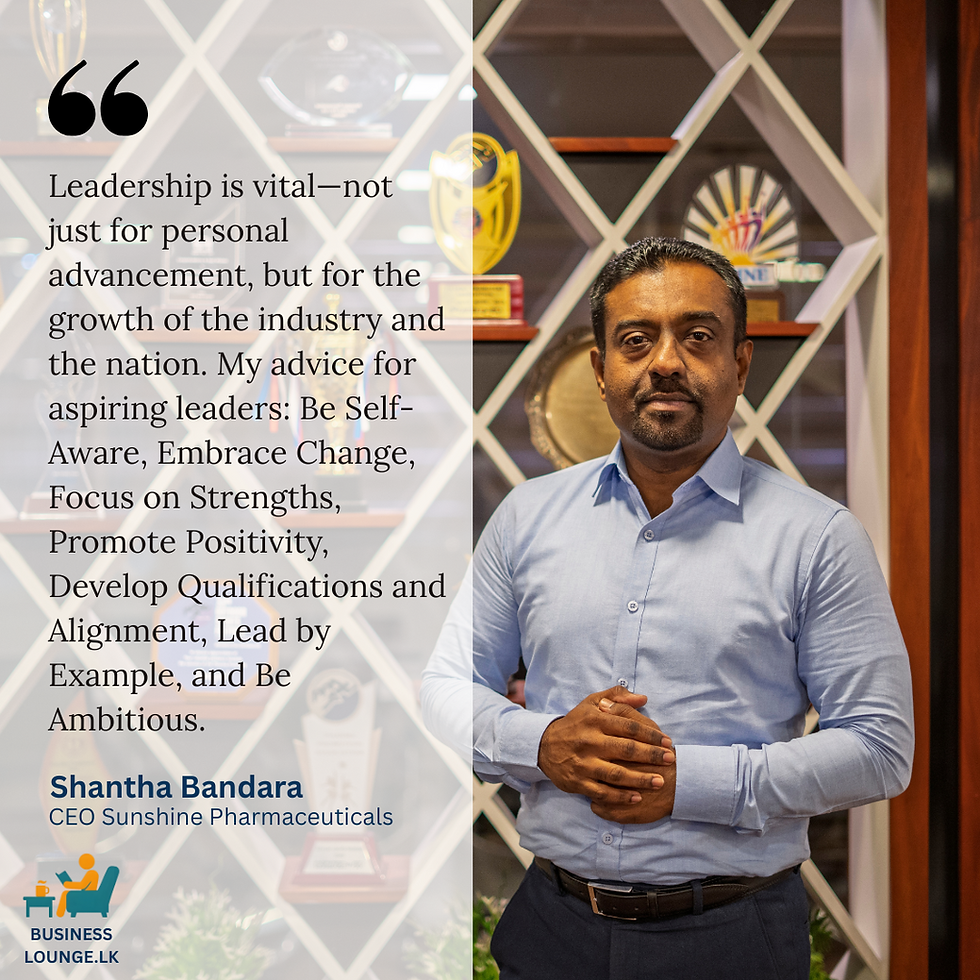
Leadership is vital—not just for personal advancement, but for the growth of the industry and the nation. My advice for aspiring leaders:
Be Self-Aware: Continuously work on yourself; no one else can do it for you.
Embrace Change: Adaptability is the key to growth and relevance.
Focus on Strengths: Build confidence by leveraging what you do best.
Promote Positivity: Energize those around you with a positive outlook.
Develop Qualifications and Alignment: Stay focused and aligned with your goals.
Lead by Example: Help others rise to leadership roles.
Be Ambitious: Strive for success but also help others along the way.
Unlocking National Potential
Sri Lanka is full of talented, ambitious, and emotionally intelligent individuals—qualities that make for effective leaders. By embracing leadership, technology, and continuous improvement, we can elevate the pharmaceutical industry and contribute to national progress.


Comments