
Revolutionizing Sri Lanka's L&D with trainings.lk

1: How did you get started with trainings.lk, and what inspired its creation?
I graduated from a university in the physical sciences stream but pivoted to HR due to proximity to a company near my home, despite lacking a formal HR background. Seeking specialization, I chose training and development in 2014, believing I had natural trainer qualities. While pursuing the National Diploma in Training and Human Resource Development at the Chartered Institute of Personnel Management (CIPM), our final project required promoting a mock half-hour training program―finding participants via campaigns, leaflets at CIPM, and direct outreach when social media was nascent. That’s when the idea for a dedicated platform sparked.
In 2015, I transitioned fully into training roles and discussed with a UK-based friend his vision for a “training hub” in Sri Lanka, inspired by Asia’s hubs like Malaysia and Dubai. Combining my HR pains―mismatches in trainer selection, time-consuming searches, guesswork, and inconsistent quality―with his idea and our decade-old premium domain purchase (2014/2015), we built trainings.lk as a complete ecosystem. He supports from afar via shared access; it’s not just a site but a solution to Sri Lanka’s corporate L&D gaps, now live and linking HR functions digitally.
2: How does trainings.lk work in practice to help companies find the right corporate HR trainers?
The platform operates on a multi-layered AI matching engine built on Firebase Cloud infrastructure. When a company describes their training need―say, “critical thinking for HR teams in the banking sector”―the system doesn’t just keyword-match. It runs a synonym-aware search with fuzzy prefix matching across 25+ training domain mappings, expanding partial queries into full semantic matches. For example, typing “leadership” also searches for management, supervisory skills, team leading, and executive coaching.
Each trainer profile is scored against the query using weighted factors: training area relevance, industry experience overlap, years of experience, verified client ratings (using our 3-category review system covering Trainer Quality, Program Content, and Venue separately), language capability, delivery methods, and geographic proximity. The result is a ranked list with match percentages―e.g., 95% fit―so companies can compare objectively rather than relying on a single recommendation.
This data-driven precision eliminates common pitfalls: a banking trainer won’t be assigned to apparel middle management, because the system cross-references industry exposure, audience type, and past delivery context. Globally, this approach echoes tools like Gloat or Degreed, where AI personalization lifts L&D ROI by 40% (Gartner), fueling company growth through targeted upskilling amid talent shortages.

3: What makes trainings.lk unique compared to traditional trainer searches?
Traditional methods rely on limited, biased networks and recommendations―your L&D executive calls friends, but they can’t verify industry fit, leading to mismatches like bank experts failing in apparel.
Trainings.lk replaces this with a structured, transparent, data-driven platform. Every trainer goes through admin verification before their profile goes live. Profiles display qualifications, certifications, training areas (from 50+ categories including Leadership, 5S/Lean, HR, IT, Communication, Sales, and more), years of experience, recent clients, delivery methods, languages, and industry specializations. Companies see the complete picture before making contact.
Our 3-category review system is a key differentiator―participants rate Trainer Quality, Program Content, and Venue Facilities separately after every event, with email-verified reviews to prevent fake feedback. Reviews are aggregated with visual rating bars showing averages across all three categories. This level of transparency doesn’t exist in traditional trainer searches.
The platform also offers a complete training ecosystem beyond just search: companies can post training requirements that automatically notify matching trainers via email, register teams for events with secure PayHere payments (supporting Visa, Mastercard, bank transfers, eZ Cash, and mCash), and browse training venues with ratings, capacity, and pricing. In Sri Lanka’s evolving HR landscape (post-2022 crisis, with 70% firms prioritizing upskilling per local surveys), this democratizes access beyond elite networks. Internationally, it aligns with HR tech like Workday’s skills cloud, reducing bias by 50% (Forrester) and enabling scalable growth.
4: How is AI changing the way HR teams choose trainers, manage learning, and plan development programs―and its impact on L&D?
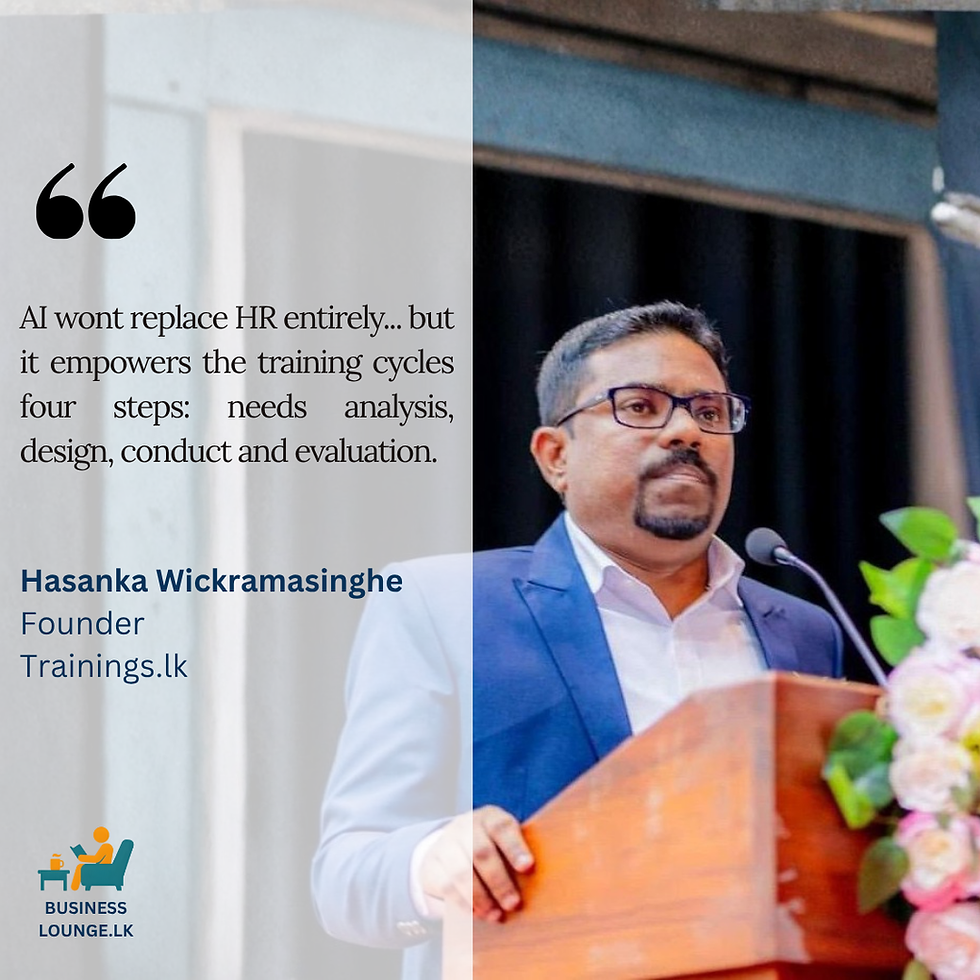
AI won’t replace HR entirely (e.g., payroll, basic recruitment, interviews can automate), but it empowers the training cycle’s four steps: needs analysis (AI scans gaps), design (tools generate content), conduct (irreplaceable human/in-person/virtual delivery), and evaluation (AI metrics).
Trainings.lk accelerates each of these steps with specific technical capabilities. For needs analysis, companies describe requirements in natural language and the AI performs semantic matching―not rigid keyword search. For evaluation, our 3-category review system captures granular feedback that feeds back into trainer ranking algorithms, continuously improving match quality over time. For conduct, trainers can create and publish events directly on the platform with agenda builders, flyer uploads, multiple date support for non-consecutive training days, and automated email reminders sent to registered participants before events.
The platform also includes 12 automated Cloud Functions handling real-time email notifications: registration confirmations to participants and event creators, account approval notifications, training request matching alerts to relevant trainers, review notifications, venue enquiry alerts, daily event reminders, and admin notifications for new registrations and events. This automation eliminates manual follow-ups that traditionally consume HR teams’ time.
In Sri Lanka, where digital HR adoption lags, this bridges to global standards―empowering SMEs to rival MNCs. Globally, AI-L&D integration drives 2.5x productivity gains (Deloitte), vital for growth: McKinsey links 21% higher profitability to upskilled workforces. As DEI evolves, platforms like ours future-proof HR against automation waves.
5: What major challenges did you face building and launching trainings.lk, and how did you overcome them?
The core challenge was my own pain―selecting trainers who delivered “nonsense” mismatched to briefs, time sinks, and guesswork―which I realized plagued all corporates. Combining ideas with my friend, we threw them to developers, prioritizing AI integration not as a business model but a problem-solver.
Technical challenges were significant. We built the entire platform on Firebase’s ecosystem―Firestore for real-time database, Firebase Authentication for secure login, Firebase Hosting for deployment, and Cloud Functions for server-side automation―using vanilla HTML5, CSS3, and JavaScript without heavy frameworks, keeping the platform lightweight and fast even on Sri Lanka’s variable internet connections. The AI matching engine required building a custom synonym map with 25+ training domain mappings and fuzzy matching algorithms tuned for Sri Lankan training terminology.
We solved the event loading performance problem by implementing batch parallel Firestore queries using Promise.all―reducing page load from 3 seconds to under 0.5 seconds for 10+ events. Firestore security rules required careful calibration to allow public read access for approved profiles while restricting write access to verified owners and admins.
Market skepticism (trust in new tech amid economic recovery) arose, but we tested rigorously in local businesses. The platform now supports the complete training lifecycle: 15 interconnected pages including dashboards for trainers, companies, venue owners, and administrators, with real-time analytics, notification systems, and SEO-optimized public pages indexed by Google. It’s a “complete training ecosystem,” not just a platform, backward-integrating with company systems for seamless L&D. In Sri Lanka’s startup scene (booming post-2024 reforms), this mirrors global fintech pivots, overcoming via user-centric iteration.
6: How do you ensure listed trainers are relevant, credible, and suitable for corporate needs?
Trust is foundational: as a registered company, we prioritize credibility via a multi-step verification process. Every trainer registration goes through admin approval before profiles become publicly visible. The admin panel provides real-time analytics across all collections―total trainers, companies, events, registrations, reviews―with pending approval queues where administrators can review, approve, suspend, or reject accounts. Trainers upload certifications (CIPM, international), portfolios, and outcomes during registration.
Quality is maintained through our email-verified review system: only participants who registered for an event (verified by matching their email against the event_registrations collection) can leave reviews. Each review captures three separate ratings―Trainer, Program, and Venue―plus written comments. Duplicate reviews are automatically blocked. These ratings feed into the trainer’s aggregate score, which the AI uses for future matching.
The platform also supports trainer profile editing with 6 comprehensive sections: Training Areas (19+ categories), Keywords/Expertise (add/remove tags), Recent Clients, Recent Trainings (title/client/date), Experience & Delivery (years, qualifications, methods, audience, industries, languages), and profile photo upload with automatic compression. This structured approach outperforms ad-hoc hires, aligning with global HR best practices (SHRM standards). For Sri Lankan growth, it builds a vetted talent pool, reducing risks and enabling 20-30% faster scaling.
7: What role should digital tools like trainings.lk play in modern HR transformation for learning and upskilling?
L&D has exploded into its own industry (Sri Lanka’s nascent but growing, tied to $1B+ HR spend regionally), demanding digital tools amid HR’s transformation―payroll, performance, grievances all digitized.
Trainings.lk leads by fully digitizing the training value chain. The platform covers the complete flow: AI-powered trainer discovery, training requirement posting with automatic trainer notification, event creation with online registration and PayHere payment integration (supporting individual and company group registrations with per-participant detail capture), venue marketplace with availability calendars, and post-training evaluation through verified 3-category reviews.
For companies, the dashboard provides centralized management: post requirements, browse and compare trainers with full profile modals showing qualifications and reviews, track training history, manage favourites, and handle all communications through the platform’s messaging system. For trainers, the dashboard offers event management, request tracking, review monitoring, and profile analytics.
The platform is also SEO-optimized with Schema.org structured data, Google Search Console integration, Google Analytics tracking across all pages, and a blog section with industry-relevant articles targeting keywords like “5S training Sri Lanka,” “leadership training Colombo,” and “corporate trainers Sri Lanka”―driving organic discovery for both trainers and companies.
Training companies (not just individual trainers) can also register with a “We also conduct training programs” option, unlocking event creation capabilities from their company dashboard―expanding the platform beyond freelance trainers to institutional training providers. In Sri Lanka (workforce upskilling critical post-crisis, with 60% youth jobless per 2025 ILO), this positions us as an Asian training hub. Globally, such tools are pivotal―World Economic Forum predicts 50% skills obsolescence by 2027; companies using AI-L&D grow 15% faster (Boston Consulting). Trainings.lk links Sri Lanka to this, empowering HR for competitive, innovative futures.


Comments